A Swift Rescue - NASA's Plan to Save the Swift Telescope

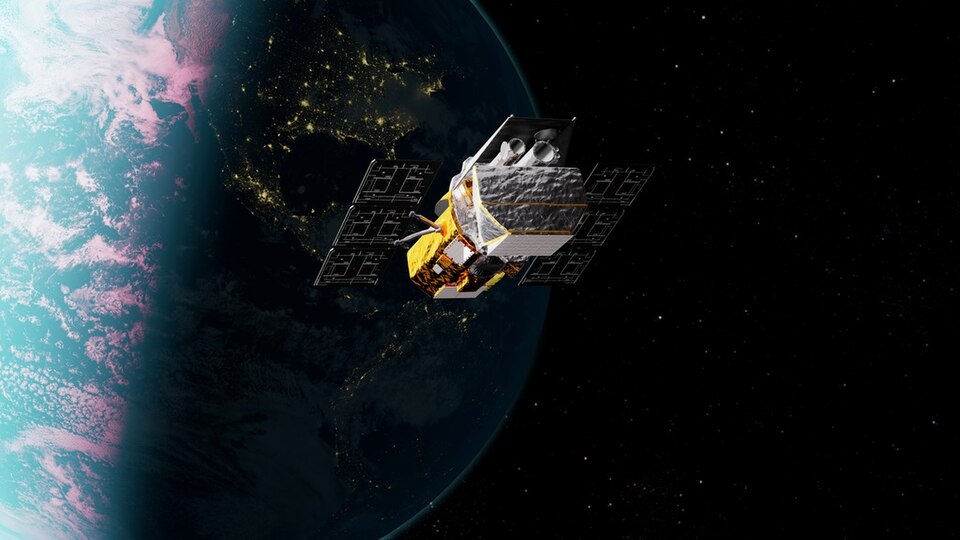
The Neil Gehrels Swift Observatory was launched in 2004 in order to study highly energetic events known as gamma-ray bursts. While it was originally planned to operate for a two-year mission, it has continued to function to this day. But if left as is, that won’t be the case for long. The telescope orbiting Earth is slowly falling back down, and without intervention, it will reenter the atmosphere before the end of 2026. But not if NASA has something to say about it. A first-of-its-kind mission will launch no earlier than Tuesday, June 30 to rescue the otherwise doomed telescope.
What is Swift?
Swift is not as powerful as other space telescopes, such as Hubble or Webb, but instead was designed for rapid response and targeting to see gamma-ray bursts. A gamma-ray burst is the most powerful event in the universe, second only to the creation of the universe during the Big Bang. They’re so energetic that we spot them in distant galaxies. They are thought to occur when an extremely massive star explodes and collapses into a black hole. Unlike many cosmic phenomena, a gamma-ray burst only lasts for a few hours at most. A telescope like Hubble can take up to two days to point at its target, so while it may take better images, it’s not going to capture the gamma-ray burst without some incredible luck. Swift, as the name implies, is designed to lock on as quickly as possible, allowing it a look at these massive explosions before they fade away. We don’t have any other space telescope with that capability.
What's Wrong With Swift?
But, after 22 years in space, Swift’s time is running out. While Swift, and other satellites orbiting Earth, are considered to be beyond what we traditionally think of as the boundary of the Earth’s atmosphere, it’s still not in a complete vacuum. There are still some stray molecules. In the short term, the minimal air resistance supplied by these molecules means nothing, but over the course of over 20 years, it adds up. The speed of the orbiting telescope has been slowed significantly over time, and the slower an object orbits, the closer to Earth it will drop. This effect has been exacerbated by the Sun, which is currently in an active phase. The higher than usual solar activity has caused Earth’s outer atmosphere to heat up, which causes it to puff outwards, meaning there’s even more atmosphere than normal for Swift to contend with.
When Swift first launched, it was 375 miles above the Earth, but today it has fallen to half that, at 186 miles. Once the telescope hits an altitude of 185 miles, it will pass a point of no return and its orbit will quickly and catastrophically decay. It was calculated that there was a 50% chance it would crash to Earth by July, and a 90% chance it would happen before the end of 2026. In order to buy it a little more time, the telescope was switched into low-power mode in February, as active use would speed up its altitude loss.
But NASA isn’t willing to let the valuable tool go without a fight. They have partnered with the space start-up Katalyst Space to construct a rescue spacecraft. The purpose-built craft and mission is costing NASA $30 million, but considering the $250 million price tag on Swift back when it was built over 20 years ago, it’s a worthwhile investment compared to building a replacement.
The Rescue Plan
Katalyst has constructed a spacecraft named LINK to rescue the failing Swift. LINK is essentially the satellite equivalent of a tugboat. As early as June 30, the craft will be launched aboard a rocket dropped from a plane in mid-flight, forgoing the traditional launch pad altogether. This gives LINK the best shot at reaching Swift in time before it hits the point of no return. Once in orbit, LINK will spend several weeks preparing for its job. It will scan the telescope from a safe distance to help ground control determine the best point to connect.
Once ready, LINK will use its uniquely designed robotic arms to latch on to Swift. When Swift was launched in 2004, it was never intended to be serviced, and as such wasn’t designed to have any sort of surface intended to be connected to. Instead, LINK will employ three robotic arms with a specialized mechanical gripper claw, which has been compared to the hand of a LEGO minifigure. The gripper will attach to a sturdy portion of the telescope’s exterior, and the tugging will begin.
Rather than a traditional chemical rocket, LINK will employ an ion engine for thrust in its recovery efforts. The explosive force of chemical thrust could easily rip the delicate Swift Telescope apart. An ion engine ejects electrically charged particles of gas for a gentle but steady thrust. The thrust power is only roughly equivalent to the weight of a piece of paper against your hand. But, over time that adds up enough to safely and gently raise the elevation of Swift. The slow and steady process could take up to three months. Once it reaches an altitude of 370 miles above Earth, LINK will detach from Swift and safely de-orbit itself, having succeeded in its mission and bought Swift many years of operation to come.
Not only will this mission save a priceless scientific instrument, but it will also serve as a proof of concept. Most satellites were not designed to be serviced. It was expected that they would eventually fall back to Earth. But it can be far cheaper and more efficient to extend their lives than to replace them. The Swift Boost Mission is the first time NASA has attempted such a feat. If all goes well, then this method could even be used to extend the lifespan of the Hubble Telescope.


Comments