The Life and Times of a Star – A Star’s Life Cycle

Updated: Sep 21
There is an estimated septillion stars in the observable universe (that’s a one followed by 24 zeroes). They’re everywhere you look and come in all sorts of varieties. Every star is unique, but they all follow a similar life cycle.
A star is a ball of gas, usually hydrogen and helium, that is so dense, it can fuse that hydrogen into heavier elements, creating energy. Depending on its size and rate of fusion, a star can live anywhere from a few million years to trillions of years. Across that lifespan, the star is continuously evolving.
A Star Is Born

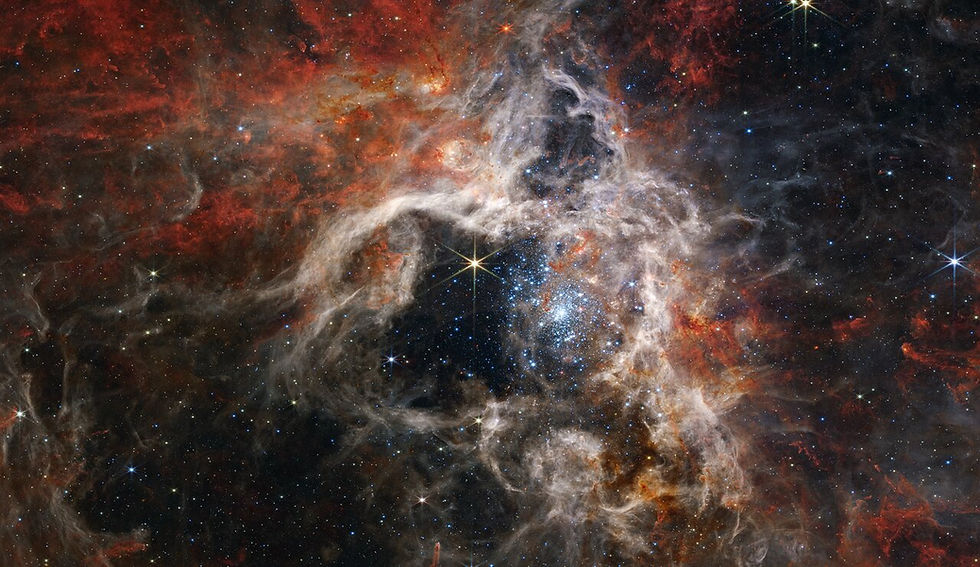
Stars are born from massive clouds of gas and dust called nebulae. A nebula carries high concentrations of hydrogen and helium, making it the perfect place for stars to form. Over time, dense pockets of the gas in a nebula will attract gas from nearby with gravity, becoming denser in the process. The denser they become, the more gravity they’ll have. And the more gravity they have, the more material they can pull in and the denser they’ll become. It’s like rolling a snowball. The bigger the snowball becomes, the more snow sticks to it, causing it to grow even faster. Eventually, this gas cluster will have enough gravity to collapse in on itself, becoming a protostar.
The gravitational collapse will not only make the protostar extremely dense, but also extremely hot. It will continue to accumulate more material from its surroundings as well. After millions of years of this, the heat and pressure in the core of the protostar will grow extreme enough to force four hydrogen atoms to combine together to form one helium atom and energy. The protostar has begun the process of nuclear fusion and has thus matured into a proper star.
The Life of a Star
Nuclear fusion is the process of combining atoms together to make heavier atoms, while also converting some of their mass into pure energy. Just a small amount of mass can convert into a massive amount of energy. The Sun transforms roughly 5 million tons of matter into energy every single second. That’s approaching the weight of the Great Pyramid of Giza. This is the primary source of heat and light of any main sequence star. A main sequence star can be thought of as an average “adult” star. The Sun exists on the main sequence.
We categorize main sequence stars based on their color, size, and luminosity. The Sun is specifically considered a yellow dwarf star. In astronomy, a star is either a giant or a dwarf, and the Sun is most definitely not a giant compared to other stars. There are other types of main sequence stars, such as red dwarfs, or high-mass blue stars. Red stars are the coolest, yellow are in the middle, and blue and white are the hottest and brightest.
How long a star’s life lasts depends on what type of star it is. A star can only live for so long as it has material to fuse. Once it runs out, it’s done. A massive blue star may have far more material for fusion than a red dwarf, but being so much hotter and brighter means it burns through the material far faster. A supergiant star will spend about 10 million years on the main sequence, while a yellow dwarf, like the Sun, can live a thousand times longer, up to 10 billion years. Meanwhile, red dwarfs are predicted to live as long as several trillion years. The universe itself is “only” 14 billion years old, meaning that in the entire history of the universe, not even the oldest red dwarf stars have met the end of their lives.
A Star Dies
As a star reaches the end of its time on the main sequence, it runs out of the hydrogen fuel it’s been fusing into helium. The rate it produces energy will diminish. Usually, a star’s surface exists in a state of tug-of-war. The outward push of the energy produced in the core balances the inwards pull of gravity. This is called hydrostatic equilibrium. But as the energy from hydrogen fusion diminishes, the star’s core will begin to shrink. This collapse of the core increases density and temperature, therefore actually increasing the outwards push of energy, causing the outer layers of the star to puff outwards, creating a red giant star. When the Sun eventually becomes a red giant star in approximately 4 to 5 billion years, its outermost layers will expand outwards somewhere between the orbits of Earth and Mars. The Earth will possibly be consumed.
In this red giant state, the star’s primary means of generating energy will shift from fusing hydrogen into helium towards fusing helium into carbon. Eventually, the red giant will run out of its remaining fuel and no longer be able to sustain its outwards push against gravity. At this point, the star will collapse, leaving behind its outermost shell as a planetary nebula.
The Afterlife of a Star

With gravity pulling everything in, a star the mass of the Sun will collapse down to the point where every single atom that makes it up is touching up against each other. Only the repulsion of the electrons of each atom keep the star from collapsing further. In this electron-degenerate state, it becomes a white dwarf. A white dwarf is no longer classified as a living star, as it no longer produces new energy. The white glow it emits is thermal energy that was entirely produced by its gravitational collapse and is slowly leaking out. It’s essentially the dead body of the star that is slowly losing its body heat. A white dwarf is predicted to last for hundreds of billions to trillions of years, once again meaning that no white dwarf in the universe has had the time to stop glowing. Once this phase ends, it will cool and dim until it becomes a black dwarf, a hypothetical form in which it would exist for an unfathomably long period.
If the dying star is far more massive than the Sun, when it collapses, it will do so far more violently, given its extra gravity. As it collapses down, it will do so with such force that new nuclear fusion will begin, and its outer layers will explode outwards in a supernova. What’s left behind after the supernova explosion depends again on how massive the star was before exploding.
On the lower end of the mass scale, a neutron star will be left behind. Like a white dwarf, a neutron star is the extremely dense remains of a star. However, its gravity was so powerful that it overcame the repulsive force of electrons and pushed the electrons all the way to the nucleus of the atom, causing the electrons and protons to combine and form neutrons. An atom is mostly empty space, but a neutron star has removed all of that empty space between the electrons and nucleus, creating the densest possible matter. Just a single tablespoon of the neutron-degenerate material from a neutron star would weigh as much as Mt. Everest. Technically, a neutron star is a single atomic nucleus the size of New York City.
But that’s not even the most extreme it can get. An even more massive star can have gravity strong enough to even force the neutrons to occupy the same space. That’s when you get a black hole, one of the most extreme objects we know of in the universe. In a black hole, the gravity is so strong that all the mass of the star has been condensed into a single infinitesimally small point. As a result, a black hole has such extreme gravity that not even light can escape from it. Hence the name black hole.
But, even after all that, the planetary nebulae left by white dwarfs and the supernova remnants left by neutron stars and black holes can spread out and enrich other stellar clouds, leading to the formation of the next generation of stars.


Comments