Earth's Evil Twin - The Extremes of Venus

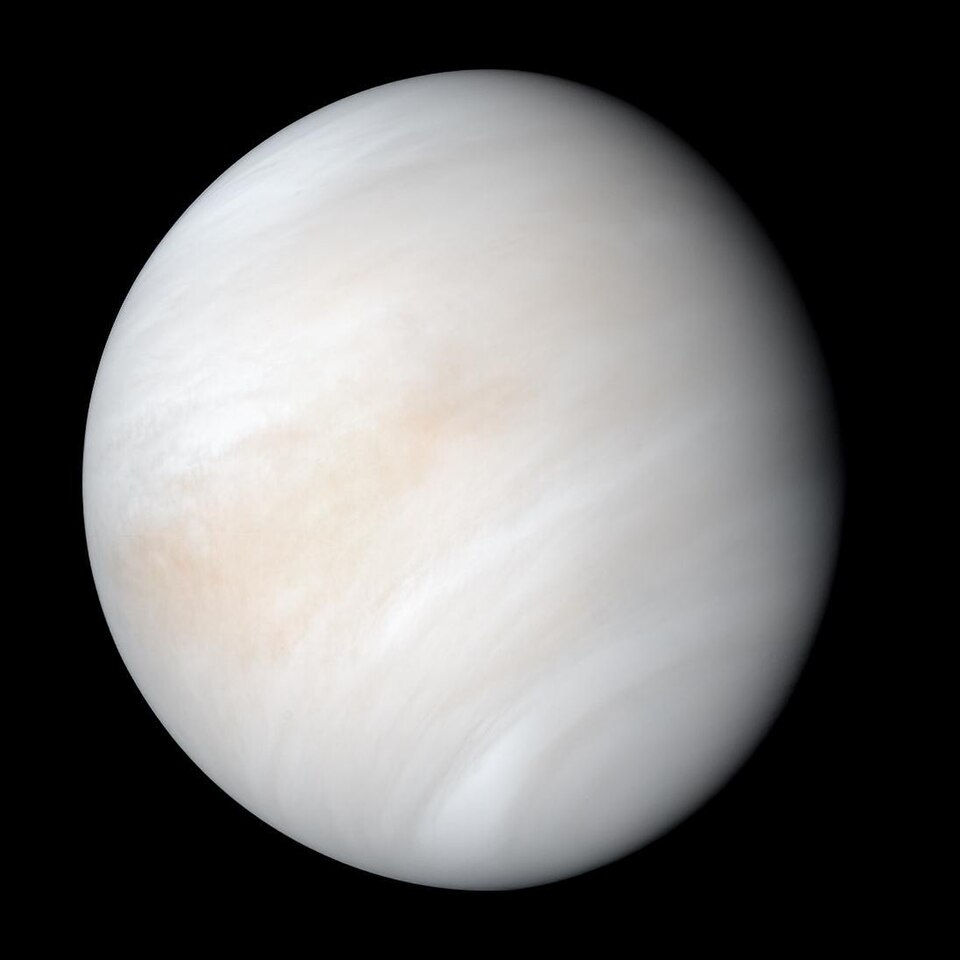
Take a look into the early evening sky any night this summer, and you’ll see a bright light over the western horizon, just above where the sun set. It looks like an incredibly bright star, but it’s actually the planet Venus. Venus has often been called Earth’s sister planet. It’s a rocky planet with about the same size and mass, as well as being the closest planet to Earth, but the similarities end there. Venus is actually about as different from Earth as a rocky planet can get, in no small part thanks to its extreme temperatures and pressures. Earth’s evil twin might be the better description.
The Morning and Evening Star
Being closer to the Sun than Earth gives Venus some odd quirks when seen in the sky. It will only ever be visible either following sunset or just before sunrise, as it will always appear close to the Sun in the sky, but is only visible when the sun is set. Additionally, Venus actually has phases like the Moon when viewed through a telescope. For planets farther from the Sun than Earth, we generally only see their fully illuminated daytime sides because the Sun is behind us when we observe them at night. But with Venus we can see both its day and night sides, depending on where it is in its orbit, so it’s possible to see a half or crescent Venus. Additionally, Venus is the brightest thing in our sky, behind only the Sun and Moon. It outshines any other planet or star, partly because of how close it is to us, but also because it’s covered entirely in reflective clouds.
A Planet of Extremes
It’s easy to assume the hottest planet in the Solar System would be Mercury. After all, being the closest planet to the Sun would mean that it receives the most direct heat from the Sun. However, Mercury’s surface temperature maxes out at 800°F (430°C), whereas Venus reaches a scorching 870°F (464°C), despite being nearly twice as far from the Sun. That’s hot enough to melt lead.
But it’s not just the heat that makes Venus so deadly. Venus also has an incredibly thick atmosphere. At surface level, the atmosphere has a pressure 92 times greater than Earth’s. This means that even if you could survive the heat, a human would be immediately crushed by the weight of the air around them alone. At this extreme pressure, the lowest level of atmosphere actually enters a supercritical phase, where it is neither a gas nor a liquid, but something with properties of both.
Venus’ extreme atmosphere is also the reason for the extreme heat of Venus, and it’s all related to global warming here on Earth. Global warming is the result of humanity releasing large amounts of greenhouse gases, such as carbon dioxide, into the Earth’s atmosphere. A greenhouse gas is transparent. That means that it doesn’t block any incoming visible light from the Sun. This visible light is free to pass to the Earth’s surface, where it warms the planet. But the planet will then release this heat back outwards in the form of infrared light. With no atmosphere, this infrared light would be able to escape into space. But greenhouse gases, while transparent to visible light, are actually opaque to infrared. Some greenhouse gases are good, as they stop the planet from getting too cold at night by trapping heat. But the more greenhouse gases you have, the more heat gets trapped, and the warmer it gets. This is known as the greenhouse effect, named as such because it works the same way as the transparent walls and roof of a greenhouse.
Despite the impact of humans on the Earth’s atmosphere, Earth only has about 0.043% carbon dioxide in its atmosphere. Meanwhile on Venus, not only does its atmosphere contain 92 times the gas of Earth’s atmosphere, that gas is composed of 96.5% carbon dioxide. All in all, Venus’ atmosphere contains over 200,000 times more carbon dioxide gas than Earth’s. Essentially, Venus has undergone an extreme runaway greenhouse effect, leading to the extreme temperature seen there today.
The carbon dioxide likely originated from planet-wide volcanism that spewed the gas in large quantities into the atmosphere. Also due to this, Venus has a large amount of sulfur in its atmosphere as well. If you thought the heat and pressure were deadly enough, then what do you think of sulfuric acid rain? Venus’ many clouds are loaded with the nasty stuff, and it rains down across the planet. However, that rain never reaches the ground, as the extreme heat evaporates it before it can ever land.
Difficulties of Exploration

Given all of these dangers on the planet, it is very difficult for a lander to survive on Venus. The first successful landing on Venus was the Soviet Union’s Venera 7, during the Space Race, which only lasted 20 minutes on the surface before being rendered inoperable. It was followed by other landers, but no lander managed to survive longer than Venera 13, which in 1982 survived for 127 minutes, despite only being designed to last for 32 minutes.
Despite these clear difficulties, manned missions may be possible to Venus in the future. These missions wouldn’t technically be landing on the surface, but instead they would utilize dirigibles to float in a layer of Venus’ atmosphere. As carbon dioxide is heavier than oxygen and nitrogen, breathable air is actually buoyant on Venus, so air could serve the dual purpose of allowing humans to breathe while also providing lift to the blimp-like aircraft they would be piloting. At the altitude of 34 miles above Venus’ surface, the atmospheric pressure drops down to half the pressure of Earth’s atmosphere and the temperature becomes a relatively comfortable 81°F (27°C), making long-term habitation possible. Future astronauts could explore and study Venus from above. It’s even conceivable that microscopic life might exist in this same layer of Venus’ atmosphere.
From both our earthly view and upon closer inspection, Venus is a fascinating planet of extremes unlike any other in our Solar System. It is simultaneously Earth’s sister world and its evil twin.


Comments