Cloud Gazing - What is a Nebula?

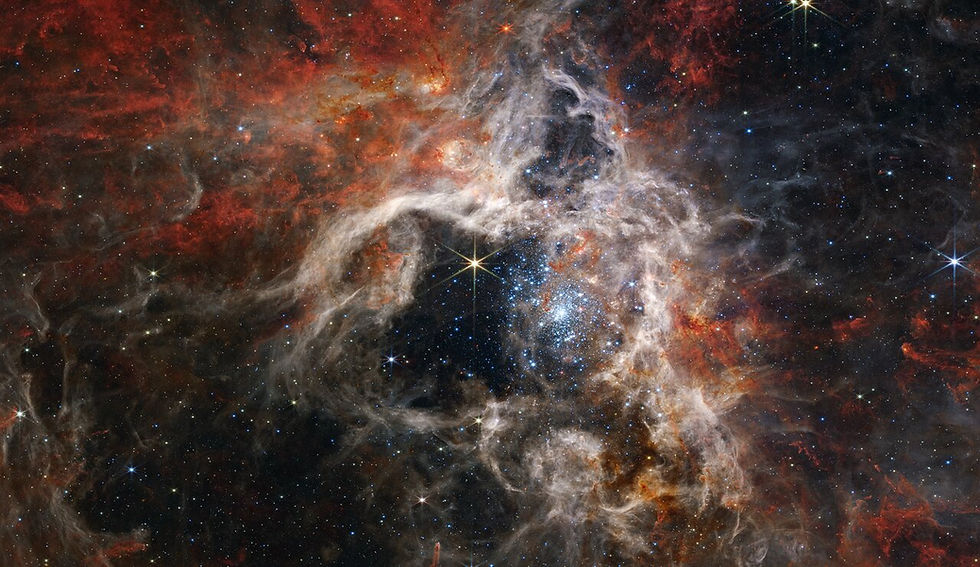
Nebulae are among the most visually stunning sights in our universe. A nebula is simply a cloud of gas and dust found in outer space, and their varied shapes and colors make them spectacular phenomena for night sky viewing. They also play important roles in the life cycle of stars, as both a place of birth and a place of death.
The word nebula comes from the Latin word meaning cloud or fog. Originally, the word was used to describe any diffuse astronomical object. We even used to call galaxies nebula before we knew what galaxies actually were. Nebulae are generally clouds composed mostly of hydrogen gas, as well as cosmic dust. There are three primary types of nebulae: diffuse nebulae, planetary nebulae, and supernova remnants.
Diffuse Nebulae: Stellar Nurseries
Diffuse nebulae are the most common type of nebula. They are vast clouds that can stretch anywhere from a few to a few hundred light-years across. Diffuse nebulae are often referred to as stellar nurseries as they are the places where stars are born. The nebulae are made primarily out of hydrogen gas, which is also what stars are made of. As nothing in nature is truly uniform, one portion of the nebula will end up denser with gas than the surrounding area. This denser area will have more gravity than the surrounding cloud, meaning it will pull more gas inwards. Having more gas means it will become even denser with even more gravity. This creates a feedback loop leading to more and more gas gathering in one spot. It’s this snowball effect that eventually results in the birth of a star.

Diffuse nebulae are either clouds of primordial gas that was left over from the Big Bang itself, or are a newer cloud of gas that was created from an accumulation of gas from dying stars in the area. Once they begin star formation, diffuse nebulae will last for millions of years. Little by little, the stars forming within will use up the vast stores of hydrogen, and once the stars have fully formed, their stellar winds will push the remaining gas away, leaving an open star cluster behind.

Diffuse nebulae come in three different subcategories. Emission nebulae are nebulae which have been ionized and illuminated by the newborn stars within. Reflection nebulae are diffuse nebulae which would usually be dark, but are illuminated by the light of outside stars reflecting off of them. Lastly are dark or absorption nebulae, completely dark clouds visible only because they block the light of stars behind them.

Planetary Nebulae: Dying Stars
The next most prominent type of nebula is the planetary nebula. Despite the name, planetary nebulae have nothing to do with planets. A planetary nebula is a typically round cloud of gas created by a dying star. When stars reach the end of their life, they will grow far larger and change color to red, becoming a red giant. Towards the end of the red giant phase, the star will begin to shed its outer layers. The gas is most often ejected equally in all directions, creating the spherical shape we commonly see in planetary nebulae.

We call them planetary nebulae because when we first spotted them, they seemed to bear a strong resemblance to planets, given their round shape. Today we know these nebulae have nothing to do with planets, but the name persists nevertheless.
Compared to diffuse nebulae, planetary nebulae are far smaller, as they only encompass a single star. They average only about a single light-year across. They are also far shorter-lived. When the red giant finally comes to the end of its life and collapses into a white dwarf, the gas cloud surrounding it will cool and become invisible to us. The phase only lasts about 10,000 years on average.
Supernova Remnants: Ghost of a Star
Supernova remnants are the final primary type of nebulae. A supernova is an incredibly powerful explosion that occurs when the most massive of stars die. Even after the primary explosion has ended, there’s still a shell of gas that was ejected by the star left hurtling outwards from the point of origin. This expanding shell also forms shock waves as it collides with the gas in the surrounding interstellar medium. It’s the afterimage of the explosion.

Supernova remnants can grow to be about 100 light-years across on average. The remnants last for tens to hundreds of thousands of years as they gradually lose velocity due to collisions with the interstellar medium. Once it has slowed to the same speed as the surrounding medium, it will integrate in and fade away. The material left behind from this expansion can help to form new diffuse nebulae and restart the star formation process, perpetuating the stellar life cycle.
Each type of nebula represents a different stage in the life cycle of a star. From birth, to death, to birth again, nebulae are an essential element of the cosmos, while also providing us with some of the most stunning sights our universe has to offer.


Comments