Building a Cosmic Neighborhood - How Did the Solar System Form?


The Solar System—the gravitational system composed of the Sun and everything that orbits it—is like our local neighborhood in space. Nearly everything within the influence of the Sun’s gravity shares a common origin. But how did it all start? How did the Solar System form?
Laying the Foundation
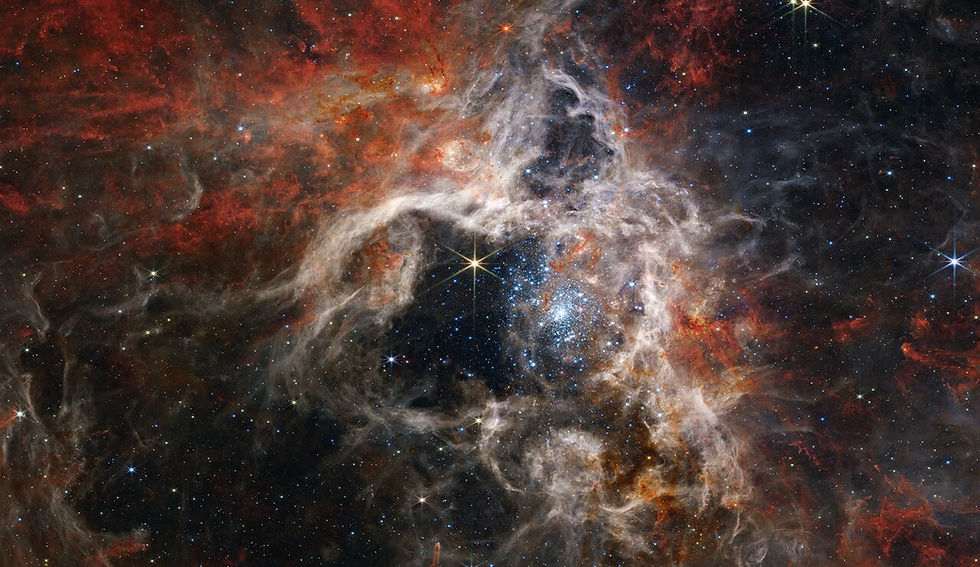
Like other stars, the Sun likely formed out of a nebula, a massive cloud in space composed almost entirely of hydrogen and helium, about 4.6 billion years ago. A cluster of gas in the nebula that’s denser than the surrounding cloud would have a greater gravitational attraction, pulling in more of the surrounding gas. The more gas pulled in, the more gravity the cluster has, allowing it to pull in even more gas. Like rolling a snowball, the larger the cluster gets, the easier it becomes to grow even larger. This kept up until the Sun as we know it formed.
The cloud that served as our Sun’s nursery is estimated to have been about 65 light-years across, and was likely home to many of the Sun’s sibling stars, which also formed around the same time. There would have been anywhere from tens to thousands of these newly born stars alongside the baby Sun. Over time, the stellar wind of these stars would have pushed away the remnant nebular cloud, blowing it away to leave behind an open star cluster. But as the stars continued to get older, it would eventually be time for them to move out of their childhood home and the cluster drifted apart, resulting in the Sun as that lone star we see today.
Building Out
As the young Sun formed, the remnants of the nebula it was created from would have formed into a protoplanetary disk. This disk was formed from the rotational motion of the gas around the baby Sun, just like how tossing a clump of pizza dough with a spin will cause it to flatten into a disk. It is from this disk that everything else in the Solar System—planets, moons, dwarf planets, asteroids, comets, etc.—formed. Having formed from the same disk of material, all the planets orbit on the same plane around the Sun and all in the same direction. Planets and other objects began as tiny dust grains that stuck together when they collided. Once these clumps were massive enough, their gravity pulled in more material, much like the Sun’s snowball effect. This process is called accretion.

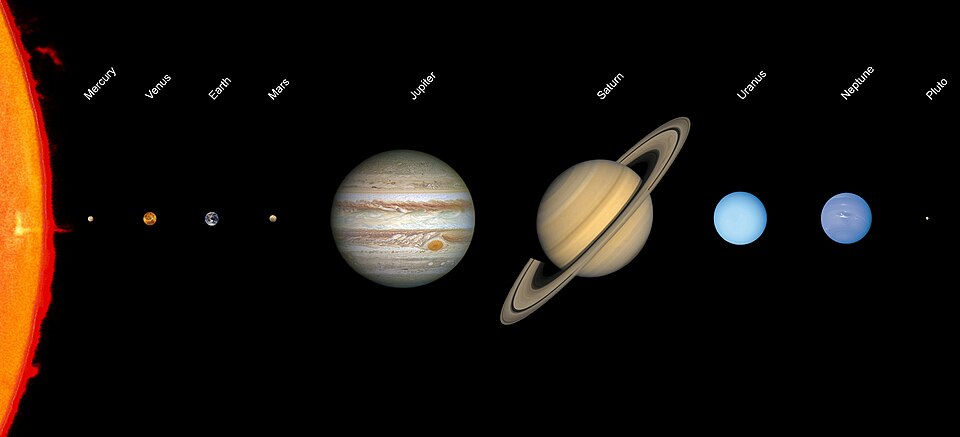
Even at this early stage of formation, the Sun controlled the evolution of the Solar System. It was the proximity to the Sun that determined what kind of planets would form. Closer to the Sun, it was very hot, so more volatile materials, those that would usually be liquid or gas at room temperature on Earth, had trouble clumping together. But material with higher melting points, such as metal and rock, was able to come together to form the terrestrial planets—Mercury, Venus, Earth, and Mars. Overall, the rock that formed those planets is relatively rare in both our Solar System and across the universe compared to gases, which limited how large the terrestrial planets could grow.
But farther from the Sun, it was far cooler. Cool enough that it was possible for gas to accrete. And since gas was far more common, the planets here that formed out of it were able to grow much larger. These are the gas giant planets—Jupiter, Saturn, Uranus, and Neptune. Even the least massive of the giants, Uranus, is about 14.5 times the mass of Earth. Jupiter, the largest planet, is 318 times more massive.
By mass, the Sun makes up the bulk of the Solar System, containing 99.86% of all the mass in it. Of the remaining 0.14% of mass, the gas giants take up 99% of it, with Jupiter alone accounting for 71% of the total planetary mass.
The Remaining Details
And just like planets formed from the leftover materials orbiting the Sun, many moons of the Solar System would have formed from leftover material orbiting the planets, while other moons would have formed disparately as large asteroids (created the same way as the planets) that were later captured by the gravity of planets. Earth’s Moon likely formed differently, via collision. In fact, collisions between forming planets would have been relatively common in the early Solar System as the newly formed planets worked out their orbital paths. When one protoplanet collided with the proto-Earth, the collision resulted in an ejection of material from the Earth out into space. Over time, this material would have cooled and coalesced to form the Moon.
A lot of things had to go right for us to be here today, not least of which is the formation of our Solar System. It ended up as the perfect home for us. It’s impossible to know exactly how our Solar System ended up the way it did, but the more we learn about it in the present, and the more we study the birth of similar solar systems, the more we learn about our own cosmic neighborhood.


Comments