Day into Night - What Causes a Solar Eclipse?


In some parts of the world on August 12, 2026, day will temporarily turn to night as the Moon passes in front of the Sun, blocking its light during a rare solar eclipse. Throughout history, solar eclipses have been viewed with a unique combination of awe and fear. As wonderful a spectacle as they are, equally interesting is the science behind them and the series of coincidences that allow them to exist.
When the Moon Meets the Sun
The cause of a solar eclipse is simple. The Moon passes in front of the Sun, which blocks its light from reaching Earth. Essentially, if you are beneath a solar eclipse, that actually means you’re in the shadow cast by the Moon as it passes by the Sun. Anyone fully beneath the shadow will experience a total solar eclipse, where the entire Sun is blocked. Anyone at an angle such that only part of the Moon passes in front of the Sun will experience a partial solar eclipse instead.

A solar eclipse can only occur during a new moon. In the lunar cycle, the full moon occurs because the Moon is on the opposite side of the Earth from the Sun, so that from our perspective on Earth, the entire side of the Moon we see is illuminated by the Sun. A new moon is the opposite. The Moon is positioned on the same side of the Earth as the Sun, meaning that the side facing towards the Earth is not lit at all. Additionally, it means that the Moon is out during the day, rather than the night, as it’s going to be near the Sun in the sky. And that’s key for an eclipse to occur.
But we have new moons once a month. Why don’t we have solar eclipses during all of them? Well, the Moon actually orbits around the Earth with a 5-degree tilt compared to the Earth’s orbit around the Sun. This means that the relative position of the Moon and Sun is slightly off from each other, so the Moon will most likely end up above or below the Sun in the sky during a new moon. There are only two points in the Moon’s orbit, called nodes, where the Moon’s orbital path would cross the path that the Sun appears to take across our sky. A solar eclipse can only occur when the Moon is at one of these two points during a new moon, which doesn’t line up often.
A Cosmic Coincidence
The fact that we can witness a solar eclipse in the first place is a cosmic coincidence. The Sun has a diameter that is about 400 times larger than the Moon, but it is also about 400 times further away from the Earth than the Moon, making it appear 400 times smaller from our perspective. By sheer coincidence, the Moon appears to be the same size as the Sun in our sky. If the Moon were any smaller or farther away then a total solar eclipse would be impossible, as the entire Moon would never be able to cover the entire Sun.
Actually, the Moon is drifting ever so slowly away from the Earth at a rate of about 1.5 inches (3.8 cm) a year. Eventually, in hundreds of millions of years, the Moon will have moved too far away from the Earth for a total solar eclipse to ever occur again.
In the Moon's Shadow

Solar eclipses are not visible in the same way across the entire planet. The shadow cast by the Moon on Earth has two parts, the umbra, which is the dark portion at the center, and the penumbra, which is the lighter portion circling the umbra. Someone in the umbra of the shadow will see a total solar eclipse, while someone in the penumbra will see a partial eclipse, hence why the penumbra is brighter than the umbra. The umbra is typically about 100 miles (160 km) across, while the penumbra is far wider and can be thousands of miles across.
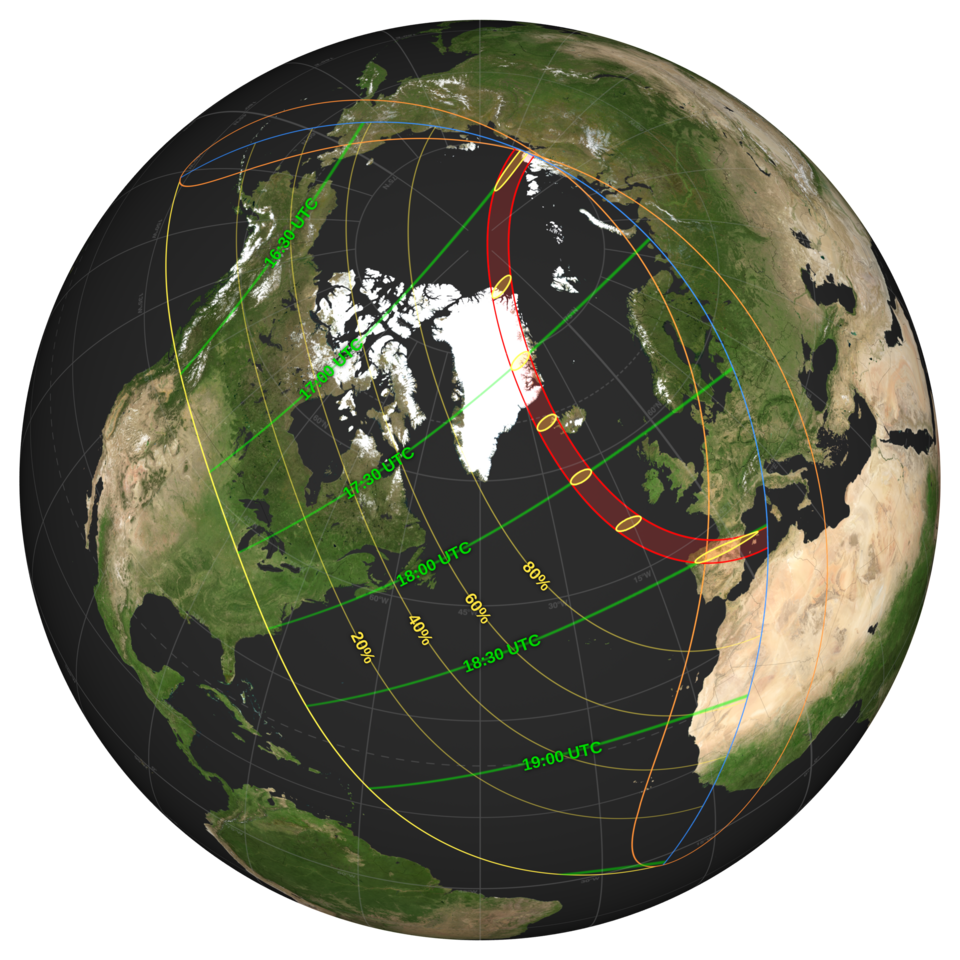
As the Earth rotates and the Moon orbits, the point on Earth where the shadow is cast will gradually change. Over time, the location of the umbra will move across the Earth, creating the path of totality. For the August 12 eclipse, the path of totality will cross Greenland, Iceland, and Spain. The partial solar eclipse will also be visible in parts of Canada, the north-eastern United States, and much of Europe.
All in all, witnessing a total solar eclipse is something that takes a lot of luck. Not only do you need to be in the right place at the right time, but the Sun and Moon need to be as well. Even the size and distances of the Sun and Moon need to line up just right. And if you’d been born millions of years in the future, you wouldn’t even have the ability to see one. So, if you ever get the chance to experience a total solar eclipse for yourself, stop and take a moment to consider just how lucky you are.


Comments