Stargazing as a Time Machine - Consequences of the Speed of Light

Updated: Mar 30

When you look up at the night sky, you’re not only looking out into space, but also back in time. You’re seeing stars that exist hundreds to thousands of light-years away, and that means you’re looking back hundreds to thousands of years into the past.
The Speed of Light
According to Einstein and his Theory of Relativity, light is the fastest thing there is, and it’s impossible to travel faster than light in a vacuum. It may feel to us on an earthly scale that light travels from place to place instantly, but there is actually a finite speed for it. The speed of light in a vacuum is precisely 299,792,458 meters per second (about 700 million miles per hour). At that speed, light could travel around the entire Earth 7.5 times in just one second. But even the 25,000-mile circumference of the Earth is nothing compared to the distances in space.
The distance from the Earth to the Sun is about 93 million miles. That’s nearly 4,000 times the distance around the Earth. This means that light traveling from the Sun to the Earth takes about 8 minutes to travel the gap. As it takes light 8 minutes to travel, we say that the Sun is 8 light-minutes away from Earth. Similarly, the distance that light travels over the course of a year is what we call a light-year. This is why light-years are a unit measuring distance, not time. A light-year is a staggering distance equal to 9,460,730,472,580.8 kilometers (about 5.88 trillion miles).
Window to the Past
The fact that light has to take time to travel from its source leads to some fascinating implications. When you look at the Sun, the light you are seeing takes 8 minutes to travel to Earth and enter your eyes, meaning that you are actually seeing what the Sun looked like 8 minutes prior. Likewise, the closest star to our Sun, Proxima Centauri, is about 4.25 light-years away, meaning if you look at it, you’re seeing it as it was just over 4 years ago. By looking at a star, you are actively looking into the past. The further away you look, the further back in time you can see.
The Andromeda Galaxy is the nearest galaxy to the Milky Way and the furthest object that can be seen with the naked eye. It’s about 2.5 million light-years away, meaning if you see it, you’re seeing that galaxy as it was at the start of the Ice Age, when the earliest ancestors of humans were first emerging. Likewise, if you were located in the Andromeda Galaxy today and somehow had a telescope powerful enough to see the Earth, you would be able to witness the Ice Age for yourself.
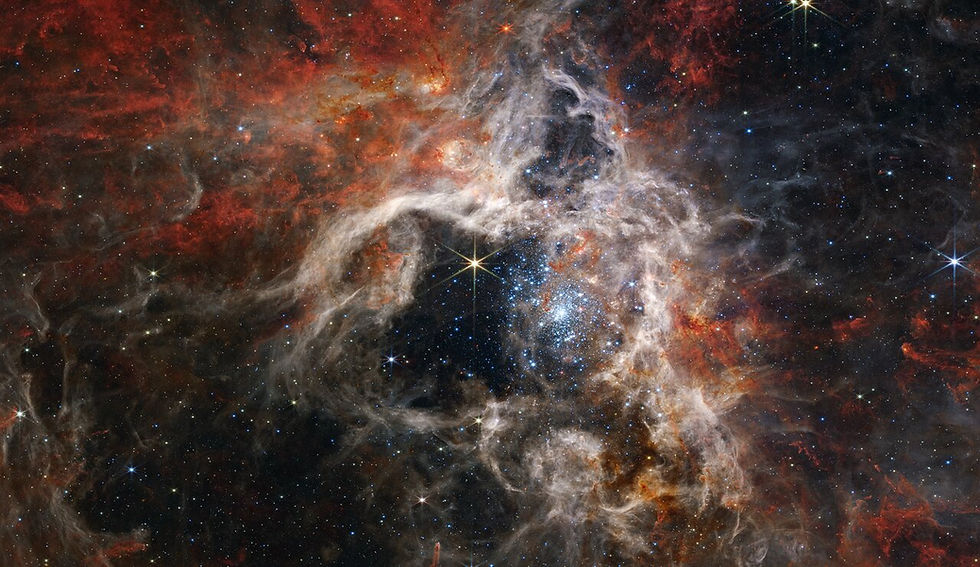
With powerful telescopes, we can see even further away and even further back in time. The farthest object we’ve seen so far is MoM-z14, an early galaxy located 13.53 billion light-years away discovered using the James Webb Space Telescope in May 2025. Current evidence suggests that the universe is approximately 13.8 billion years old, meaning our view of MoM-z14 comes from roughly 280 million years after the Big Bang and the formation of the universe—a blink of the eye by cosmic standards. By looking at distant objects, we’re able to directly study not only the universe, but its formation and history first-hand.

Cosmic Ghosts
There’s another interesting result of light travel time. Let’s imagine the Sun suddenly disappeared. We on Earth would be blissfully unaware of our coming demise for eight minutes. As it would take eight minutes for the last of the Sun’s light to reach us and for us to see the actual event of the Sun disappearing. Likewise, if you look at a random star in the sky, it’s possible that the star no longer exists. It could have died hundreds of years ago.
Betelgeuse (often pronounce “Beetlejuice”) is a bright red star in the Orion constellation, right above the famous Orion’s Belt. The star is a red supergiant, meaning that it’s at the end of its life. It will likely explode as a supernova sometime in the next 100,000 years. Now, that may sound like a long time but compared to its approximately 10-million-year life span, that’s not long at all. Betelgeuse could conceivably go supernova within the next several hundred years. And, seeing as Betelgeuse is about 600 light-years from Earth, it’s possible that the star has already died and that the light we’re seeing is some of the last it ever made before its final supernova show. Perhaps the light of that supernova is on its way to Earth right now as we speak.
So, next time you look up at the stars, don’t just think about how far away they are, but how distant they are in the past too. The night sky is your very own window into history. It’s a time machine that anyone can peer into.


Comments